
GROWTH
TOO SMALL, TOO TALL OR OUTSIDE THE USUAL SIZE RANGE?
What girl or boy doesn’t want to grow up beautiful, tall, and strong like everyone else? Parents worry because people who are unusually short or tall often face difficulties in life.
It is very important that children grow and gain weight. Growth and weight gain are direct indicators of whether an infant, toddler, school-age child, or adolescent is in good health. Insufficient growth and delayed physical development can be early signs of a chronic illness. Body height also influences the psychosocial development of our children.

FAMILIAL HEIGHT
ONLINE FAMILIAL HEIGHT CALCULATOR
HOW DO CHILDREN INHERIT THEIR HEIGHT?
As with hair color and other aspects of physical appearance, heredity also plays an important role in height. Because genetics sets the framework for body height, the so-called “target height” can be estimated based on the parents’ height.
In this calculation, a height difference of 13 cm between adult men and adult women is assumed. However, it is important to emphasize that even today we know very little about how final height and the rate at which it is reached are inherited. The inheritance of height appears to be relatively complex.
MORE
It is clear that tall parents generally tend to have tall children, and short parents tend to have short children. Nevertheless, it still happens that short parents have tall children and tall parents have short children. However, there is no doubt that height is inherited in some way. Ideally, it would be possible to calculate exactly what height parents pass on to their children. For this reason, various models attempt to estimate the genetic height potential, the so-called “target height” of a given family. All of these models have their advantages and disadvantages. Some are simple to calculate, others help improve understanding, and some are more complex and therefore more precise, but can only be calculated with a computer.
TWO METHODS BRIEFLY EXPLAINED
The genetic growth potential a child has inherited from their parents can be calculated.
METHOD A) SIMPLE CALCULATION
Based on the parents’ genders, a target height can be determined fairly easily. This method is helpful for explanation and understanding.
In one of the first systematic studies by James M. Tanner, a difference of 13 cm between adult men and adult women was found. This 13 cm difference still forms the basis for calculating the so-called family target height range that a child may inherit. Simply put, one can say:
A girl inherits:
- from her father, his height minus 13 cm
- from her mother, her height
A boy inherits:
- from his father, his height
- from his mother, her height plus 13 cm
MORE
If a child were to inherit exactly the height of both parents and each parent’s height contributed exactly half to the child’s final height, the following two calculation formulas would apply:
The formula for girls is:
Target height = (Father’s height – 13 cm)/2 + Mother’s height/2
The formula for boys is:
Target height = (Mother’s height + 13 cm)/2 + Father’s height/2
Or: (Mother’s height + Father’s height)/2 + 6.5 cm for boys = Tanner target height
(Mother’s height + Father’s height)/2 - 6.5 cm for girls = Tanner target height
But how accurate is this formula? It is least accurate when the parents’ heights differ greatly. Let’s take a less extreme example: both parents of a girl are 170 cm tall. The father is relatively short compared to other men, while the mother is relatively tall for a woman. The mother contributed the full 170 cm of her height genetically to her daughter. The father, also 170 cm tall, contributed his “virtual female height” of 157 cm to his daughter, since if he were a woman, he would be 13 cm shorter. Simply put, there are three possibilities for the daughter’s growth: she may resemble the father more, the mother more, or end up as a mix of both parents.
- Gender-adjusted height of the mother
so in this example 170 cm, because she is a girl. She could have inherited her mother’s height.
- Gender-adjusted height of the father,
so in this example 170 − 13 = 157 cm, because she is a girl. She could have inherited her father’s height.
- The sex-adjusted heights of both parents divided by two,
so in this example (157 cm + 170 cm)/2 = 163.5 cm, she could also have inherited an optimal combination of both parents.
For this reason, it makes sense to plot three different target heights on the growth chart. This allows you to see at a glance whether the child is likely to grow within the parents’ target height range.
For clearer understanding, consider the situation of a son whose father and mother are each 170 cm tall…
- Gender-adjusted height of the mother
so in this example 170 + 13 cm = 183 cm, because he is a boy. He could have inherited his mother’s height.
- Gender-adjusted height of the father,
so in this example 170 cm, because he is a boy. He could have inherited his father’s height.
- The sex-adjusted heights of both parents divided by two,
so in this example (183 cm + 170 cm)/2 = 178.5 cm, he could also have inherited an optimal combination of both parents.
METHOD B) EXACT CALCULATION
Using the Cole–Hermanussen method, a more precise target height can be determined. It is closer to the expected real outcome but more complex to calculate.
cTHSDS = (father’s height in SDS + mother’s height in SDS) / 2 × 0.72
The models described above, which aim to estimate the inherited potential for adult height, are useful for understanding the concept and are easy to calculate. However, especially in extreme cases—when parents are very tall or very short—they tend to give results that are too extreme. In many biological processes, there is a tendency toward the average, and this also applies to growth. On average, the children of very tall parents are somewhat less tall than one might expect based on the calculation models above. The same applies to the children of very short parents, who are on average less short than expected. This effect is taken into account in the Cole–Hermanussen formula. However, it can only be calculated using a calculator. In our reports, the results of all these calculation methods are listed—something our patients greatly appreciate.
How the hereditary transmission of body height actually works in detail remains largely unknown. Calculations suggest that information determining final adult height must be located at at least four different sites in the genome.
GROWTH CURVES
EVERY CHILD NEEDS A GROWTH CHART
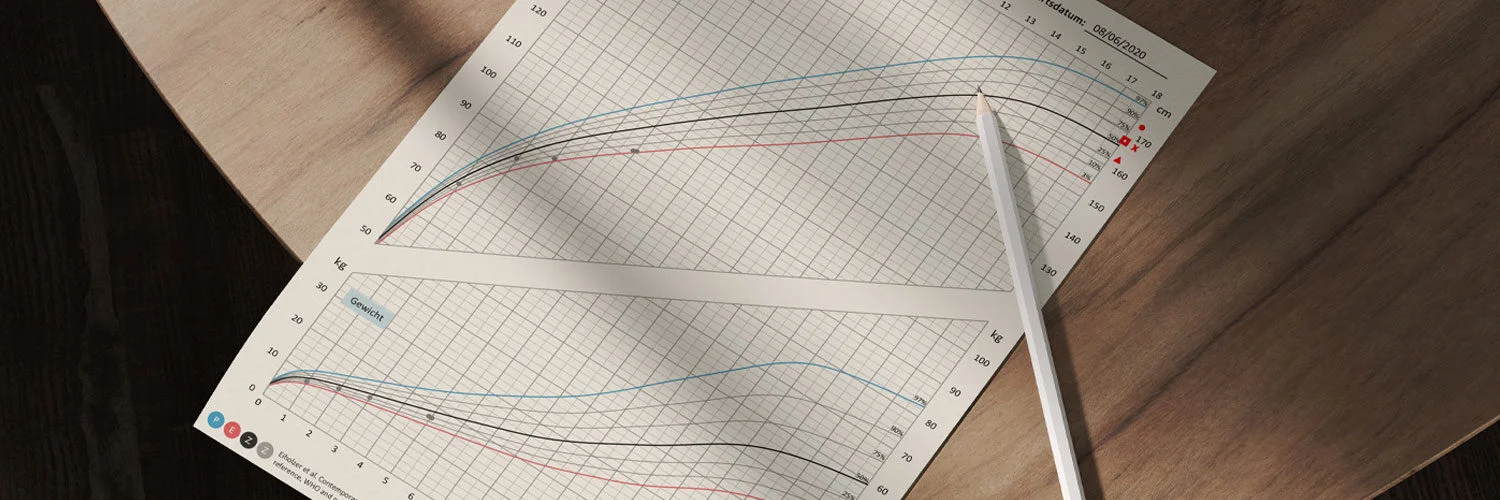
Is my child too short, too tall, or within the typical average for their age? The simplest way to find out is by using a growth chart.
A newborn’s length and weight generally reflect how well the child developed in the womb during pregnancy. After birth, the child has time to adjust their growth in the first two years of life to the pattern inherited from their genes. After the second year, growth follows the inherited percentile channel.
During the first two years of life, “shifts” in the percentile curve are simply signs of this adjustment and not an indication of a growth disorder. After the second birthday, growth should follow its inherited track—the percentile channel—and remain within this channel until the onset of puberty. For example, a boy who is on the 50th percentile at age 2 should continue to grow along the 50th percentile, his inherited percentile channel, until around age 12. A change in the percentile channel would be a suspicious sign of a possible growth disorder.
The term “growth chart” is not entirely accurate. It is actually a size comparison chart, where a child’s or adolescent’s height is compared over the years with that of peers, using standard values plotted as percentile curves. The 50th percentile corresponds to the average growth of a healthy child. A growth chart is therefore a graph on which multiple measurements of a child’s height can be plotted and compared using standard curves, the so-called percentiles
MORE
In growth, we refer to growth charts or percentile charts.
Both terms mean the same thing. The percentile chart is by no means complicated—it is a practical and clear tool without any hidden secrets. Parents can easily track and interpret the percentile chart themselves. Specialists agree that children and adolescents with a recorded height below the 3rd percentile—i.e., below the three-percent threshold—should be considered too short. Children and adolescents with measurements above the 97th percentile are considered too tall.
What does, for example, a position on the 10th percentile mean? Out of 100 healthy children of the same age and sex, 9 are smaller and 90 are taller. Every child needs a growth chart. To monitor growth, this chart must be carefully maintained—whether by the school doctor, the pediatrician, or the parents. Who maintains it is not so important. What matters is that each child is measured at least once a year as accurately as possible, and the measurements are plotted or entered on a percentile chart. The course of the chart is a very sensitive indicator of whether the child’s growth mechanism is functioning properly—for example, whether the intestines and kidneys are healthy and whether thyroid, growth, adrenal, and sex hormones are all in order.
DOWNLOAD TAB
PERCENTILE CURVES FOR THE MEDICAL PRACTICE
Between 2017 and 2024, over 100 paediatricians’ practices and 30 schools worked with us to measure and weigh more than 43,000 children. This has resulted in the first updated Swiss growth charts for 35 years.
Using newly collected data, we were able to create new up-to-date Swiss growth charts. The charts are available here for convenient download.
WEIGHT CURVES
THICKER OR THINNER? WEIGHT CHARTS AS COMPARISON TOOLS
AS YOU GROW, YOU ALSO GET HEAVIER
As a parent, you may be concerned that your child has become heavier or thinner while growing. How can you determine whether the weight gain during childhood and adolescence actually corresponds to the increase in height? How can you assess whether your child has gained weight in proportion to their growth? Similar to evaluating height, a comparison chart can help here as well: the percentile chart for weight.
DO GROWTH AND WEIGHT PROGRESS IN THE SAME WAY?
Assume that the weight plotted on the chart lies roughly midway between the 50th and the 3rd percentile curves, for example at the 25th percentile. This would mean that, out of 100 children of the same age, 24 weigh less and 75 weigh more. In this case, weight—like height—is being compared with that of peers of the same age. However, there is a problem. As soon as a child is taller or shorter than average, a weight value referenced only to age becomes rather meaningless. What we really want to know is whether the child’s weight is appropriate for their height. Therefore, we do not need a curve that represents weight as a function of age, but rather one that shows weight in relation to height. In other words, instead of a “weight-for-age” curve, we need a “weight-for-height” curve—and such curves do exist. We first calculated these curves 25 years ago in Zurich.
MORE
We believe that “weight-for-height” charts are much more informative and easier to interpret for growing children than the BMI charts commonly used in other countries. BMI is an artificial measure: weight in kilograms divided by height in centimeters squared (kg/cm²). Because BMI has proven practical in adults, it was later adopted in pediatrics, particularly for defining overweight and obesity. However, there are good reasons to use “weight-for-height” instead of BMI, especially when monitoring weight development over time, when a child’s height deviates significantly from the age-appropriate average, or in children under 2 years old. Both the percentile chart for “weight-for-height” and the BMI chart provide the information needed to determine whether a child is normal weight for their height or whether they have become heavier or lighter over the years.
DOWNLOAD TAB
PERCENTILE CURVES FOR THE MEDICAL PRACTICE
Between 2017 and 2024, over 100 paediatricians’ practices and 30 schools worked with us to measure and weigh more than 43,000 children. This has resulted in the first updated Swiss growth charts for 35 years.
Using newly collected data, we were able to create new up-to-date Swiss growth charts. The charts are available here for convenient download.
BUCH TAB

ACCURATE MEASURING
ALWAYS MEASURE CHILDREN AT THE SAME TIME
The body can shrink by up to 15 mm during the day because the intervertebral discs lose fluid as the day progresses. At night, while lying down and sleeping, the discs can rehydrate and regain height, much like a sponge soaking up water. That’s why it’s important to always measure children at the same time.
IN EVERYDAY FAMILY LIFE, THE EVENING IS THE BEST TIME FOR MEASUREMENTS.
The child must stand completely straight, as if at a military parade. We do not want to measure a slouched body, but the full height of the child, reaching as tall as possible. Be careful, though: young children tend to rise onto their toes and lift their heels. It is therefore helpful to have a second person assist during the measurement, pressing both of the child’s feet firmly to the floor. A measuring device ensures that the measurement above the head is taken at a precise right angle to the wall.
IF NO MEASURING DEVICE IS AVAILABLE?
In that case, you can use a book, holding it upright against the wall. Lower the book to the highest point of the child’s head. Then mark the bottom edge of the book on the wall with a small pencil line. From the floor, the mark can be measured vertically using a tape measure or ruler. You can erase the mark afterward or leave it and add the date of measurement and the child’s name. Why is precise measurement important? Even in medical offices, measurement errors of 2 to 3 cm sometimes occur. Such errors can make it impossible to accurately assess growth. For example, a 10-year-old child grows about 5 cm per year. If we measure the child twice a year, we expect a difference of about 2.5 cm. With a measurement error of 2.5 cm, it becomes impossible to determine whether growth over the past year was normal

BONE AGE
SAME DATE OF BIRTH – BUT NOT BIOLOGICALLY THE SAME AGE
A child who was among the smallest may grow to be of average height as an adult. A child who was among the tallest may not become particularly tall as an adult. You have undoubtedly heard of such cases in your circle of acquaintances. But how does this happen? How can this paradox be explained? Children can be the same age chronologically, but differ in bone maturation (biological age).
THE CRUCIAL POINT IS PUBERTAL DEVELOPMENT
More precisely, it is the timing of the onset of puberty. If puberty begins early, growth ends early. Conversely, if puberty starts late, growth also ends later.
Affected children may continue to grow even when all their peers have already reached their adult height. This gives rise to “early developers” and “late developers.” In medical terminology, this is referred to as “constitutional delay” or “constitutional acceleration of growth and pubertal development.” Again, inheritance plays a role, as the “schedule”—the tendency to develop early or late—is passed down. The same “development patterns” tend to repeat within the same families. An average-height mother reports: “I was always the smallest in school and kept growing for a long time. I had my first period at 16. And now my daughter is also among the smaller ones.”
MORE
The course of a child’s growth can be predicted with more or less accuracy as early as preschool age. From the second birthday onwards, biological age can be determined using a hand X-ray. Contrary to what many people think, this does not involve measuring the size or length of individual hand bones, but rather assessing their three-dimensional shape. This shape is interpreted by the observer from the two-dimensional hand X-ray.
THE SHAPE OF EACH HAND BONE
Each bone is assigned to a specific stage of maturation. Depending on the method, the maturation stages of 13 or 20 different hand bones are assessed and then averaged as accurately as possible. The resulting bone age reflects the biological age. As a child grows older, the determination of biological age becomes increasingly precise. The hand X-ray can also be used to estimate the child’s future adult height.
MORE
This is a scientifically sound and completely reliable method. Based on the hand X-ray, experienced doctors can estimate when puberty is likely to begin and whether it will start early or late.
WHEN THE BODY DOESN’T FOLLOW THE SCHEDULE
In some children, the body does not strictly follow the time set by clocks and calendars. When the body is “in a hurry,” development proceeds faster: the biological age is ahead of the chronological age, puberty begins earlier, and the child reaches adult height sooner. Conversely, the body can take a very slow pace, with delayed development: puberty starts later, growth continues longer, and the child reaches adult height later than the average of peers—usually without any underlying medical disorder.
DETERMINATION OF BONE AGE
There are various methods available for determining bone age. Be careful: there are not many doctors with enough experience to determine bone age from a hand X-ray with sufficient accuracy. It requires a great deal of experience. Only those who assess more than a hundred bone ages each year using different methods have the expertise to reliably determine bone age and estimate future adult height. This also explains why many young adults are disappointed that they did not reach the height they expected: “My doctor predicted I would grow to 180 cm, and now I’m only 165 cm and no longer growing…”

GROWTH PREDICTION
GROWTH AND GROWTH PREDICTION
In the evaluation of growth problems, determining the so-called bone age and calculating the predicted adult height play a central role.
Whenever possible, bone age is determined using the Greulich-Pyle and Tanner methods (TW2 and TW3), and growth predictions are calculated according to Bayley-Pinneau, Roche, and Tanner (TW2 and TW3). In addition, a clinical assessment is carried out as far as the available data allow.
HOW RELIABLE ARE THE SO-CALLED GROWTH PREDICTIONS?
Once biological age has been determined using a hand X-ray, the further course of growth and biological development can be predicted with reasonable accuracy. It is then possible to estimate when puberty and the pubertal growth spurt will begin, how long growth will continue, and to make predictions about the expected adult height. There are various methods for performing these calculations.
ACCURACY
Their accuracy depends on whether subsequent growth continues more or less along an average pattern. Growth is not average, for example, when body proportions are very unusual or if the child was born SGA, that is, “small for gestational age.”
MORE
A large percentage of SGA children do not grow exactly like most other children. Often, they experience a small growth spurt around 8–10 years of age. Unfortunately, in such cases, the pubertal growth spurt contributes less additional height than it does for most other children. This results in an adult height that is smaller than originally predicted. We have only known this for a few years, after analyzing cases of children who did not reach the height we had initially forecast.
BONE AGE ASSESSMENT
So far, we have discussed biologically unusual growth patterns. There is another, much more common source of error. All methods for calculating growth predictions rely heavily on the accuracy of bone age assessment. Determining bone age is not a simple task. It involves analyzing the maturation of 13 or 20 hand bones. It is therefore not about the measurable size or length of the hand bones, but about assessing their three-dimensional shape, which must be assigned to different stages of maturation.
MORE
The more experienced the person interpreting the hand X-ray, the more accurate the growth predictions—regardless of the method used. Doctors experienced in reading bone age often use multiple methods simultaneously, as the differences between methods can provide insight into the reliability of the prediction in a specific case. The greatest experience in reading bone age is usually found among pediatric endocrinologists, specialists in growth and hormonal disorders.
THE MORE A CHILD GROWS NORMALLY, THE MORE ACCURATE THE GROWTH PREDICTIONS ARE.
In general, one can also say that the more normally a child grows, the more accurate the growth predictions are. However, growth predictions are most often of interest not for children with average growth, but for those with unusual growth patterns. Growth predictions are a kind of “by-product” of determining bone age. The main purpose of assessing bone age is to find out whether a child has a disease or growth disorder, and if so, what type it might be.

GENETICALLY DETERMINED GROWTH DISORDERS
DOWNLOAD TAB
Fachzeitschrift Pädiatrie 2023
Tagesanzeiger 2024
An important part of our work is advising whether genetic testing is appropriate. Growth is largely determined by genetic factors—about 80% of growth variation can be explained genetically, usually involving multiple genes. Common genetic variants (present in less than 5% of the population) account for roughly 50% of differences in adult height. While not all relevant genes are known yet, this gap in knowledge is expected to be filled in the coming years.
Severe growth disorders, on the other hand, are often caused by rare genetic variants. The smaller a child is, the higher the likelihood that a single-gene change or a rare variant in one gene is responsible. Our counseling on possible genetic growth disorders is clear and open-ended—it is not meant to push toward any specific decision. Like any medical test, DNA analyses have their limitations: they usually detect only the most common genetic changes. Even when a genetic variant is identified, it is often not possible to predict with certainty if or when a disorder will actually manifest.
From our many years of experience, we know when a genetic test is the appropriate next step. If there is sufficient indication, we arrange a genetic analysis at Genetica, depending on the specific question.
Genetica offers state-of-the-art molecular genetics (gene analyses) and cytogenetics (chromosome analyses). Their testing spectrum includes all relevant modern molecular genetics methods (NGS, array-CGH, NIPT, Optical Genome Mapping, etc.) as well as classic cell culture techniques for chromosome diagnostics from chorionic villi, amniotic fluid, and blood.