
HORMONAL DISORDERS
THE ENDOCRINE SYSTEM IS A NETWORK OF ORGANS SPECIALIZED IN THE PRODUCTION AND RELEASE OF BIOLOGICALLY ACTIVE SUBSTANCES ("HORMONES").
Hormones transmit regulatory signals, for example from the diencephalon to the ovaries, which in turn regulate the uterus through hormones. For growth and development during childhood, the following hormone-producing organs (“glands”) are particularly important: thyroid gland, adrenal glands, testes/ovaries, and pituitary gland.

THE THYROID GLAND REGULATES METABOLISM
IN CASE OF UNDER- OR OVERACTIVITY OF THE THYROID GLAND, TREATMENT IS RECOMMENDED.
The thyroid gland is located at the front of the neck, just below the larynx. It consists of two lobes that surround the trachea in a horseshoe shape. At normal size, it is not palpable; an enlargement (known as a “goiter”) can sometimes be visible even without palpation. The thyroid produces the iodine-containing hormones thyroxine (T4) and triiodothyronine (T3), which play a crucial role in regulating metabolism. The appropriate amount of thyroxine must always be released into the bloodstream to adapt metabolism to changing external conditions.
HYPOTHYROIDISM (UNDERACTIVE THYROID)
There are congenital and acquired forms of hypothyroidism. Both are associated with symptoms of markedly reduced metabolism (e.g. slowed growth, reduced heart rate, decreased performance and concentration, constipation, weight gain, sensitivity to cold, and chronic fatigue). Particularly severe consequences occur in the relatively common congenital form (affecting about 1 in 4,000 newborns), which, if left untreated, can lead to severe intellectual disability and growth failure. For this reason, all newborns are screened for this condition as part of neonatal screening (so-called Guthrie test) and, if necessary, treated early with thyroid hormones.
MORE
With treatment started in time and well managed, affected children develop normally. Acquired forms of hypothyroidism can also occur later in life. Most commonly, this is due to insufficient iodine intake (iodine is an essential component of thyroid hormones) or inflammation of the thyroid gland. An inadequate production of TSH by the pituitary gland can also lead to hypothyroidism (see pituitary insufficiency)).
HYPERTHYROIDISM (OVERACTIVE THYROID)
Hyperthyroidism is very rarely congenital; most cases are acquired and occur in the context of thyroid inflammation (Graves’ disease) or due to so-called “adenomas.” Adenomas are thyroid nodules that are no longer regulated by TSH but instead produce thyroxine autonomously and without control. Possible symptoms of increased metabolism include accelerated growth, restlessness, rapid heartbeat, excessive sweating, tremor, diarrhea, and weight loss.
MORE
Treatment usually consists of medications that inhibit thyroid hormone production. In rare cases, surgery or radioiodine therapy is necessary.
An enlarged thyroid (goiter) can be caused by either underactivity or overactivity. For an accurate diagnosis, in addition to taking the patient’s symptoms into account, a blood test and an ultrasound examination are necessary. These also allow for precise measurement of the thyroid’s size.
ADRENAL GLANDS
PRODUCTION OF SO-CALLED STEROID HORMONES SUCH AS CORTISOL, ANDROSTENEDIONE, AND ALDOSTERONE
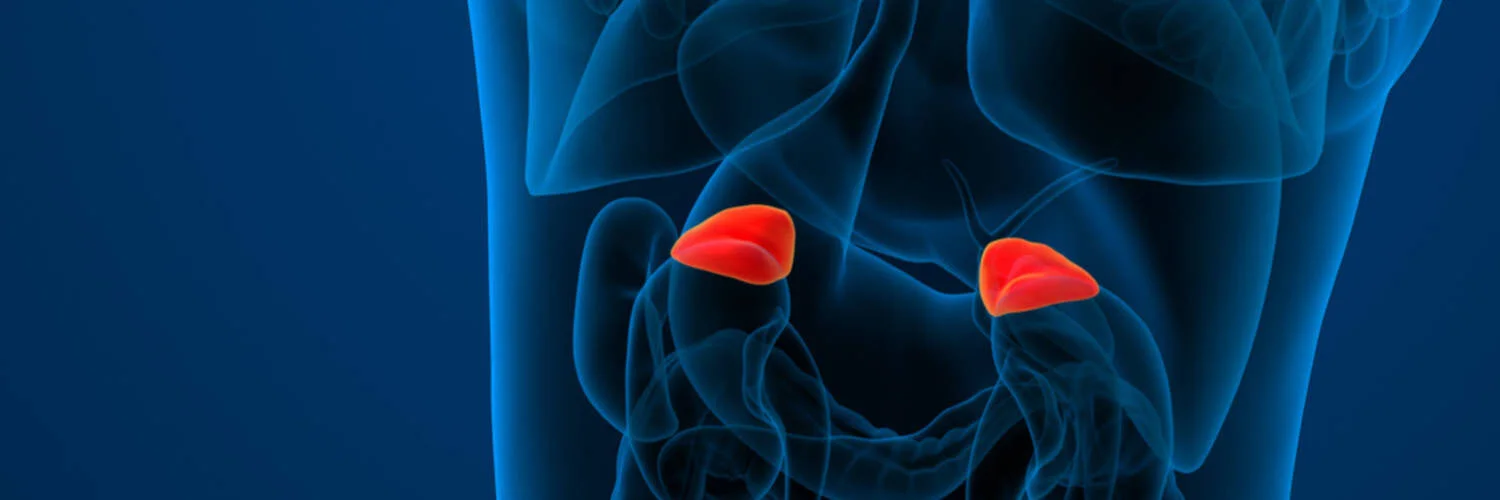
The adrenal glands are two glands located above the kidneys on the right and left sides, and they are not directly related to kidney function. They consist of the adrenal cortex and the adrenal medulla. The main function of the adrenal cortex is the production of so-called steroid hormones: “stress hormones” (e.g. cortisol), various sex hormones (e.g. androstenedione), as well as hormones important for salt and fluid balance (e.g. aldosterone). Hormone secretion is partly regulated by the pituitary gland (Pituitary gland).
Several intermediate products (hormones) are synthesized in the adrenal glands, which in turn often serve as the starting point for new compounds. Various enzymes (catalysts) are essential for the production of these different hormones, as they carry out the chemical reactions involved. The adrenal medulla produces the so-called fight-or-flight hormones, adrenaline and noradrenaline.
If the adrenal glands are not functioning normally, a distinction must be made between
HYPERFUNCTION OF THE ADRENAL CORTEX
An overproduction of cortisol (Cushing’s syndrome) occurs either due to excessive production of the upstream regulatory hormone ACTH (Cushing’s disease) or as a result of a hormone-producing tumor of the adrenal gland. Typical signs include weight gain—especially in the face (“moon face”)—with stunted growth, wide red stretch marks on the abdomen and thighs, high blood pressure, muscle weakness, and often increased body hair.
HYPOFUNCTION OF THE ADRENAL CORTEX
Addison’s disease is a disorder of the adrenal cortex characterized by reduced production of the hormones cortisol and aldosterone. It is also referred to as adrenal insufficiency. The most common cause is inflammation of the adrenal glands triggered by an autoimmune reaction. For reasons that are not yet fully understood, the body’s immune system turns against the adrenal tissue and destroys it. In slowly developing, long-standing adrenal insufficiency, symptoms include loss of appetite and nausea, sometimes accompanied by vomiting, leading to weight loss. Patients feel very tired, and physical performance decreases. The body’s ability to fight infections is also reduced. Blood pressure is low, and due to sodium deficiency, there is often a craving for salt. In addition, there may be a brownish discoloration of the skin or of pre-existing scars.
Acute destruction of the adrenal gland can lead to the life-threatening “Addisonian crisis.”
In Addison’s disease, the hormone deficiency must be compensated for throughout life with hormone replacement therapy.
In congenital adrenal hyperplasia (adrenogenital syndrome), too little cortisol is produced, while at the same time—essentially as a compensatory overflow reaction—too many male sex hormones are produced.

TESTES / OVARIES
THE GONADS PLAY A DECISIVE ROLE IN DEVELOPMENT.
Delayed pubertal development can be caused by a disorder of the gonads, but it can also simply be the result of a delay as a normal variant. In both boys and girls, there are “late bloomers” or “late developers” who enter puberty later (parents often report similar patterns in themselves; see also puberty). Through a physical examination, including an X-ray of the hand and, depending on the situation, a blood test, we can determine the underlying cause and whether treatment is necessary.
Depending on the sex, a distinction is made between
DISORDERS OF TESTICULAR FUNCTION IN BOYS
The male gonads in boys—the testes—contain seminiferous tubules for the production of sperm cells, as well as specialized cells (Leydig cells) that produce the male sex hormone (testosterone). Both processes are regulated by the upstream control hormones LH and FSH from the pituitary gland.
MORE
Testosterone is particularly important during puberty for the development of male sexual characteristics, the growth spurt, voice deepening, the development of pubic, axillary, and facial hair, increased muscle growth, and the stimulation of sperm production.
Disorders of testicular function can affect sperm production, testosterone production, or both. Depending on the case, this may lead to incomplete development of male sexual characteristics, disturbances in pubertal development, and infertility.
Causes may include direct damage to the testes, congenital enzyme defects, or again a disturbed secretion of regulatory hormones from the pituitary gland (see Klinefelter syndrome,, Kallmann Syndrome).From a therapeutic perspective, male sex hormones must be replaced in order to enable normal pubertal development in adolescents.
DISORDERS OF OVARIAN FUNCTION IN GIRLS
In girls, the reproductive organs consist of two ovaries (an ovary shown in the red box), the fallopian tubes, the uterus, and the vagina. At birth, the ovaries of a newborn girl already contain hundreds of thousands of immature egg cells, which mature during puberty. An important role in pubertal development is played by the stimulating gonadotropins (LH, FSH) from the pituitary gland and the female sex hormones estrogen and progesterone produced by the ovaries.
MORE
Testosterone is also produced in small amounts in the ovaries (and in the adrenal glands). In addition to pubertal development, female sex hormones are also important for growth and bone health.
In the case of impaired ovarian function, pubertal development may be incomplete or absent depending on the severity, which can lead to infertility if left untreated. To ensure normal pubertal development in such cases, female sex hormones generally need to be administered according to a carefully age-adjusted regimen (see also Turner Syndrome).
THE PITUITARY GLAND (HYPOPHYSIS)
THE LEADER OF ALL ENDOCRINE GLANDS
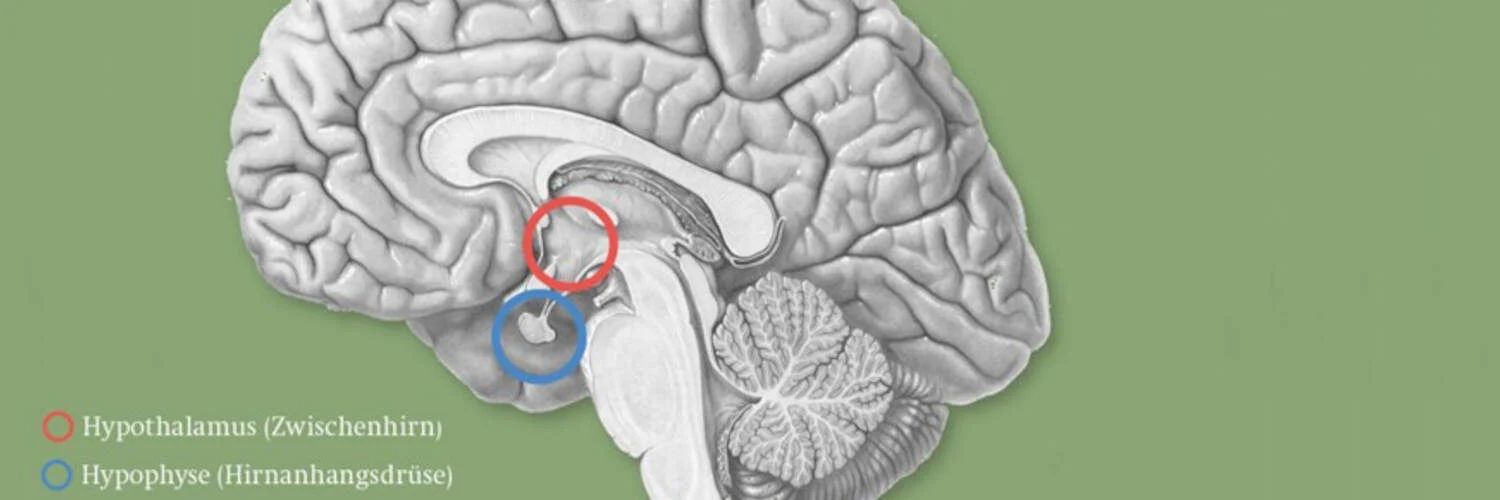
The pituitary gland (shown in the blue circle) is the master gland of the endocrine system. It consists of an anterior and a posterior lobe. The anterior lobe produces hormones that regulate other glands in the body: TSH (thyroid-stimulating hormone) controls the function of the thyroid gland, ACTH (adrenocorticotropic hormone) regulates the adrenal cortex, and the gonadotropins LH (luteinizing hormone) and FSH (follicle-stimulating hormone) regulate the testes and ovaries, respectively. In addition, growth hormone and prolactin are produced. The posterior lobe mainly produces vasopressin (antidiuretic hormone, ADH), which in turn regulates urine concentration.
THE CONTROL SYSTEM
Regulation takes place through various feedback loops that link the interacting glands. The control system aims to maintain balance and can continuously adapt to new situations. This is usually achieved through negative feedback, meaning that any disturbance in the system triggers a response that counteracts the disturbance.
An insufficient production of pituitary hormones can occur either individually or in various combinations. Combined deficiencies of several hormones are typically seen after tumors or injuries that damage the pituitary gland, or in developmental disorders in which the formation of the pituitary is already impaired before birth.
A deficiency of various pituitary hormones is also referred to as “pituitary insufficiency” or “panhypopituitarism.” The pituitary gland is controlled by the diencephalon (shown in the red circle).

CONGENITAL ADRENAL HYPERPLASIA (CAH)
PREVENT VIRILIZATION AND PREMATURE PUBERTY
Congenital adrenal hyperplasia (CAH) is a genetically determined disorder with regionally varying prevalence (in Switzerland approximately 1:5,000). Due to different enzyme defects, steroid hormone production in the adrenal cortex is impaired. This results, on the one hand, in too little cortisol being produced and, on the other hand, in excess precursor hormones forming as a kind of overflow product. These usually have androgenic effects (similar to male sex hormones) and in turn lead to undesirable effects.
Bei der häufigsten Form des AGS, dem Mangel am Enzym 21-Hydroxylase, kommt es zu einem lebensgefährlichen Mangel an Cortisol. Gleichzeitig entstehen anstelle des Cortisols Hormone vom männlichen Typ, welche beim weiblichen Fötus während der Schwangerschaft zu einer Vermännlichung des Genitales führen. Falls die Krankheit nicht richtig behandelt wird, bleiben die überschüssigen Hormone vom männlichen Typ bestehen und führen beim Mädchen weiterhin zur Vermännlichung und bei beiden Geschlechtern zu einer Beschleunigung der biologischen Reifung und auch zu einem deutlich zu frühen Eintritt der Pubertätsentwicklung.
OVERVIEW OF ADRENAL CORTEX FUNCTION
The three main products of the adrenal glands are cortisol, aldosterone, and androgens (male-type hormones). In congenital adrenal hyperplasia, cortisol production is impaired. This leads to excessive stimulation of the adrenal glands by adrenocorticotropic hormone (ACTH). As a result of this overstimulation, increased amounts of androgens are released. Depending on the form of congenital adrenal hyperplasia, aldosterone production may also be impaired.
MORE
Because in some cases salt regulation is also impaired (due to too little aldosterone), affected children may become life-threateningly ill in the second week of life due to the associated salt loss. The salt loss is accompanied by fluid loss, which can lead to rapid and severe dehydration within a very short time. This can result in severe dehydration and cardiac arrest.
For this reason, all newborns have been screened for this disorder as part of neonatal screening (the so-called Guthrie test) for several years, and treated with medication at an early stage if necessary.
Treatment mainly consists of replacing the missing cortisol (substitution therapy). The goal of the medication is to ensure that the blood cortisol levels in a child with CAH are as close as possible to those of a healthy child.
This also leads to the normalization of male sex hormone levels. An insufficient dose of cortisol replacement results in elevated androgen levels, which in turn accelerate bone maturation and temporarily increase growth. This is only temporary because puberty—and therefore the end of growth—occurs too early in this situation, ultimately resulting in children being significantly shorter than would be expected based on their parents’ height.
To monitor the therapy, blood samples are taken at regular intervals, in which the levels of various hormone precursors are measured. In addition, hand X-rays are regularly performed to assess bone maturation (biological age).

DIABETES
LIVE AND AGE WELL WITH DIABETES
Has your child recently been diagnosed with diabetes, and is everyday life now resuming at home, at school, or during training? Would you like to make changes to the current insulin therapy because you are not satisfied or want to make daily life more flexible? These are situations in which personal, professional, and comprehensive care can provide important support.
We aim to help children and adolescents manage their diabetes so that growth and development can proceed normally.
At the same time, the treatment should enable the affected children to lead as normal a daily life as possible and help prevent long-term complications of diabetes through good control.
As part of personalized care, the treatment plan, insulin therapy, and blood glucose monitoring are tailored to the individual needs of the child and their family. Depending on the child’s and family’s needs, advanced technologies such as insulin pumps or continuous glucose monitoring may be used. The consultation serves to discuss the current situation and to adjust treatment goals and strategies to the needs of the child or adolescent and their family. Our clinic is open to everyone, either through direct registration or by referral from a physician.
Comprehensive care may include, depending on the situation and age group: a diabetologist, a pediatrician or general practitioner, dietitians and diabetes educators, and psychologists. In most cases, the diabetologist coordinates and organizes the care. Our goal is to work closely with the local resources available in each case
EXPERIENCES OF OTHER AFFECTED FAMILIES
For affected children and parents, it is often helpful to hear about the experiences of other families in a similar situation. Therefore, we recommend that all families become members of the “Swiss Diabetes Kids” association. Membership is free; the association aims to support families with children with diabetes and to provide them with an optimal platform for information and exchange.